
IMDG Dangerous Goods Classes 1-9: Complete 2026 Guide
Understand all nine IMDG hazard classes, every formal division, common cargo examples and the information buyers should verify before booking packaged dangerous goods by sea.
Key takeaways
- The nine class numbers identify the type of transport hazard, not a ranking from least to most dangerous.
- Only Classes 1, 2, 4, 5 and 6 have formal divisions in the Class 1-9 framework; Classes 3, 7, 8 and 9 do not.
- The UN number, Proper Shipping Name and Dangerous Goods List entry control the final class, subsidiary risk, packing group and transport provisions.
- A marine pollutant can belong to another primary class; marine pollutant status is not automatically the same as Class 9.
Buyer checklist
- Current SDS, preferably from the actual manufacturer and product grade
- UN number and exact Proper Shipping Name
- Primary class or division and every subsidiary risk
- Packing group, when the entry assigns one
- Marine pollutant status and flash point, when applicable
- Package type, net quantity, gross quantity and package count
- IMDG-compliant marks, labels, packaging and container segregation
- Dangerous Goods Declaration and Container Packing Certificate
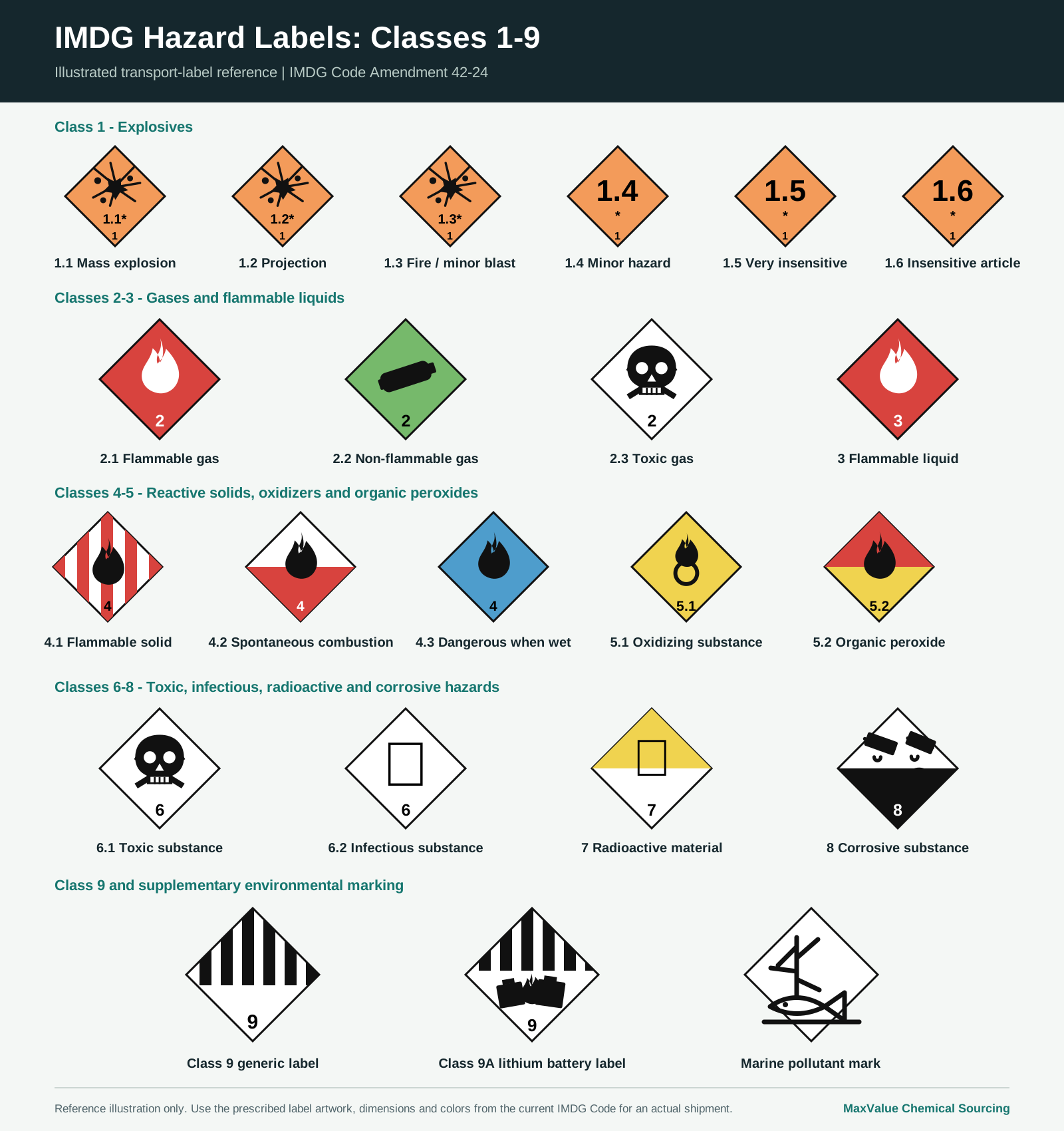
Quick reference
All IMDG classes and formal divisions
Explosives
- 1.1 - Mass explosion hazard
- 1.2 - Projection hazard, but no mass explosion hazard
- 1.3 - Fire hazard with minor blast or projection hazard, but no mass explosion hazard
- 1.4 - No significant hazard beyond the package
- 1.5 - Very insensitive substances with a mass explosion hazard
- 1.6 - Extremely insensitive articles without a mass explosion hazard
Examples: Fireworks, detonators, ammunition and certain explosive articles.
Buyer note: The division and compatibility-group letter both matter. Compatibility groups affect stowage and segregation and must be taken from the assigned entry.
Gases
- 2.1 - Flammable gases
- 2.2 - Non-flammable, non-toxic gases
- 2.3 - Toxic gases
Examples: Propane, nitrogen, carbon dioxide, oxygen, chlorine and ammonia.
Buyer note: Gas classification also depends on physical state and additional hazards. Oxygen, for example, is Division 2.2 but may carry an oxidizing subsidiary risk.
Flammable Liquids
No formal numbered divisions.
Examples: Many solvents, thinners, solvent-based paints, alcohols and fuel-related products.
Buyer note: Class 3 has no formal divisions. Flash point is important, but the final classification must follow the exact IMDG criteria and Dangerous Goods List entry.
Flammable Solids and Related Hazards
- 4.1 - Flammable solids, self-reactive substances, solid desensitized explosives and polymerizing substances
- 4.2 - Substances liable to spontaneous combustion
- 4.3 - Substances which, in contact with water, emit flammable gases
Examples: Sulfur, matches, self-heating materials, sodium metal and calcium carbide.
Buyer note: The three divisions describe very different reactions. Storage, moisture protection and temperature control cannot be inferred from the class number alone.
Oxidizing Substances and Organic Peroxides
- 5.1 - Oxidizing substances
- 5.2 - Organic peroxides
Examples: Calcium hypochlorite, ammonium nitrate and methyl ethyl ketone peroxide formulations.
Buyer note: Oxidizers can intensify combustion without being fuels themselves. Organic peroxides may also be temperature-sensitive and subject to control or emergency temperatures.
Toxic and Infectious Substances
- 6.1 - Toxic substances
- 6.2 - Infectious substances
Examples: Certain pesticides, cyanides, toxic intermediates, clinical specimens and infectious cultures.
Buyer note: Division 6.1 concerns chemical toxicity; Division 6.2 concerns pathogens. They use different classification, packaging and documentation systems.
Radioactive Material
No formal numbered divisions.
Examples: Certain medical isotopes, industrial gauges, radioactive sources and nuclear-cycle materials.
Buyer note: Class 7 has no numbered divisions. Package category, activity, radiation level, fissile status and competent-authority requirements may control the shipment.
Corrosive Substances
No formal numbered divisions.
Examples: Sulfuric acid, hydrochloric acid, sodium hydroxide and many corrosive cleaning or treatment products.
Buyer note: Class 8 covers substances that damage skin or corrode metals under the transport criteria. Compatibility between the product, inner packaging and closure is critical.
Miscellaneous Dangerous Substances and Articles
No formal numbered divisions.
Examples: Lithium batteries, dry ice, asbestos, environmentally hazardous substances and various regulated articles.
Buyer note: Class 9 has no formal divisions. Label model 9A is a special Class 9 label for specified lithium battery entries; 9A is not a separate division.
What is the IMDG Code?
The International Maritime Dangerous Goods Code is the global framework used for dangerous goods carried by sea in packaged form. It connects classification with packaging, marking, labelling, documentation, stowage, segregation and emergency-response information. The IMO confirms that the 2024 Edition incorporating Amendment 42-24 became mandatory on 1 January 2026.
This guide explains the class structure for buyers, importers and sourcing teams. It does not replace the current IMDG Code, the Dangerous Goods List, competent-authority decisions, carrier acceptance rules or advice from a trained dangerous-goods professional.
How IMDG classification actually works
A product is not classified by choosing the label that looks closest to its general risk. Classification begins with identity and composition, then applies the relevant test criteria and precedence-of-hazards rules. The result should point to a UN number and Proper Shipping Name in the Dangerous Goods List.
That entry provides or directs the user to the primary class or division, subsidiary risk, packing group where applicable, special provisions, limited-quantity status, packing instructions, portable-tank provisions, EmS information and stowage or segregation requirements. A commercial name such as coating additive, biocide or cleaning agent is not enough to make this decision.
Class 1: Explosives
Class 1 covers explosive substances and articles and is divided into 1.1 through 1.6. Division 1.1 presents a mass explosion hazard. Division 1.2 presents a projection hazard without mass explosion. Division 1.3 presents a fire hazard with minor blast or projection effects. Division 1.4 presents no significant hazard beyond the package under normal transport conditions. Divisions 1.5 and 1.6 cover very insensitive substances or extremely insensitive articles under their respective criteria.
Class 1 entries also use compatibility-group letters. Buyers should never treat two Class 1 products as automatically compatible simply because the division number is the same. Specialist classification, packaging and carrier acceptance are essential.
Class 2: Gases
Division 2.1 covers flammable gases such as propane. Division 2.2 covers non-flammable, non-toxic gases such as nitrogen or carbon dioxide. Division 2.3 covers toxic gases such as chlorine. Gas cargoes may be compressed, liquefied, dissolved, refrigerated liquefied, adsorbed or contained in articles, and that physical condition affects the applicable entry and packaging.
A gas may also have a subsidiary risk. Oxygen is a familiar example of a non-flammable gas that supports combustion. Buyers must match the exact gas, concentration, receptacle and pressure conditions to the correct UN entry rather than relying only on the product name.
Class 3: Flammable liquids
Class 3 includes liquids that meet the IMDG flammability criteria, including many solvents, thinners, alcohols, solvent-based paints and related mixtures. Class 3 has no formal divisions. Packing Groups I, II or III may be assigned according to the applicable criteria and entry.
Flash point is a key data point, normally reported using an accepted closed-cup method, but it is not the only issue. Viscosity provisions, composition, subsidiary hazards and specific or generic Dangerous Goods List entries can change how a product is shipped. A water-based trade description does not by itself prove that a formulation is non-dangerous.
Class 4: Flammable solids and reactive substances
Division 4.1 includes flammable solids, self-reactive substances, solid desensitized explosives and polymerizing substances. Division 4.2 covers substances liable to spontaneous combustion, including pyrophoric and self-heating materials under the relevant criteria. Division 4.3 covers substances that emit flammable gases when they contact water.
These divisions require different controls. A 4.3 product may need rigorous moisture exclusion, while a self-reactive 4.1 product may have temperature-control provisions. The buyer should verify the exact entry, packaging material, stabilization or temperature conditions and segregation requirements.
Class 5: Oxidizers and organic peroxides
Division 5.1 covers oxidizing substances. They may not be combustible themselves, but they can cause or contribute to combustion of other materials. Common commercial examples include certain grades of calcium hypochlorite and ammonium nitrate, although exact classification depends on composition and form.
Division 5.2 covers organic peroxides. Some entries are sensitive to heat, friction or contamination and may require control and emergency temperatures. Diluent type, concentration, formulation and packaging method are therefore essential classification data. A product family name alone is insufficient.
Class 6: Toxic and infectious substances
Division 6.1 covers toxic substances that can cause death, serious injury or harm when swallowed, inhaled or absorbed through the skin under the transport criteria. Examples may include certain pesticides, cyanides and toxic chemical intermediates. Packing group, route of exposure and subsidiary risks must be checked from the applicable entry.
Division 6.2 covers substances known or reasonably expected to contain pathogens. Category A infectious substances, Category B biological substances and exempt specimens follow specific definitions and packing provisions. This division is fundamentally different from chemical toxicity and normally requires specialized medical or laboratory shipping knowledge.
Class 7: Radioactive material
Class 7 has no numbered divisions. It covers radioactive material meeting the transport definitions and includes a detailed system based on activity, radionuclide, package type, radiation level, transport index, criticality safety and other factors. Package categories and labels are not equivalent to class divisions.
Radioactive shipments may require competent-authority approval, specialized packages and carrier arrangements. Buyers should involve appropriately qualified specialists at the earliest stage.
Class 8: Corrosive substances
Class 8 covers substances that cause severe skin damage or materially damage other goods or the means of transport by corrosion under the applicable criteria. Acids, alkalis and formulated industrial products can fall into this class. Examples include sulfuric acid, hydrochloric acid and sodium hydroxide solutions.
Class 8 has no formal divisions, but packing group and subsidiary risks may apply. Packaging compatibility matters: the container, gasket, closure and liner must withstand the actual formulation and concentration throughout transport.
Class 9: Miscellaneous dangerous substances and articles
Class 9 covers dangerous substances and articles presenting a transport hazard not covered by the other classes. Examples include many lithium battery entries, dry ice, asbestos, certain environmentally hazardous substances and various regulated articles. Class 9 has no formal divisions.
The black-and-white label model 9A is used for specified lithium battery entries, but 9A is a label model, not a new class or division. Battery chemistry, watt-hour rating or lithium content, test status, state of charge, condition and whether batteries are packed alone, with equipment or contained in equipment can change the applicable UN entry and requirements.
Packing Groups I, II and III
Where assigned, Packing Group I indicates high danger, Packing Group II medium danger and Packing Group III low danger for packaging purposes. Packing group is not a universal severity score and is not assigned to every dangerous good.
Classes 1, 2 and 7, Divisions 5.2 and 6.2, self-reactive substances of Division 4.1 and many articles do not use the normal Packing Group I-III system. Never invent a packing group because a booking form requires a value; verify the exact Dangerous Goods List entry.
Marine pollutants are not automatically Class 9
Marine pollutant status is an additional environmental transport consideration. A flammable, toxic or corrosive product may retain Class 3, 6.1 or 8 as its primary hazard and also require the marine pollutant mark. Conversely, environmentally hazardous substances assigned to UN 3077 or UN 3082 are common Class 9 entries.
For mixtures, concentration thresholds, named substances and any applicable special provisions must be reviewed. The marine pollutant mark does not replace the primary hazard label or subsidiary-risk label.
What buyers should request before a sea-freight quote
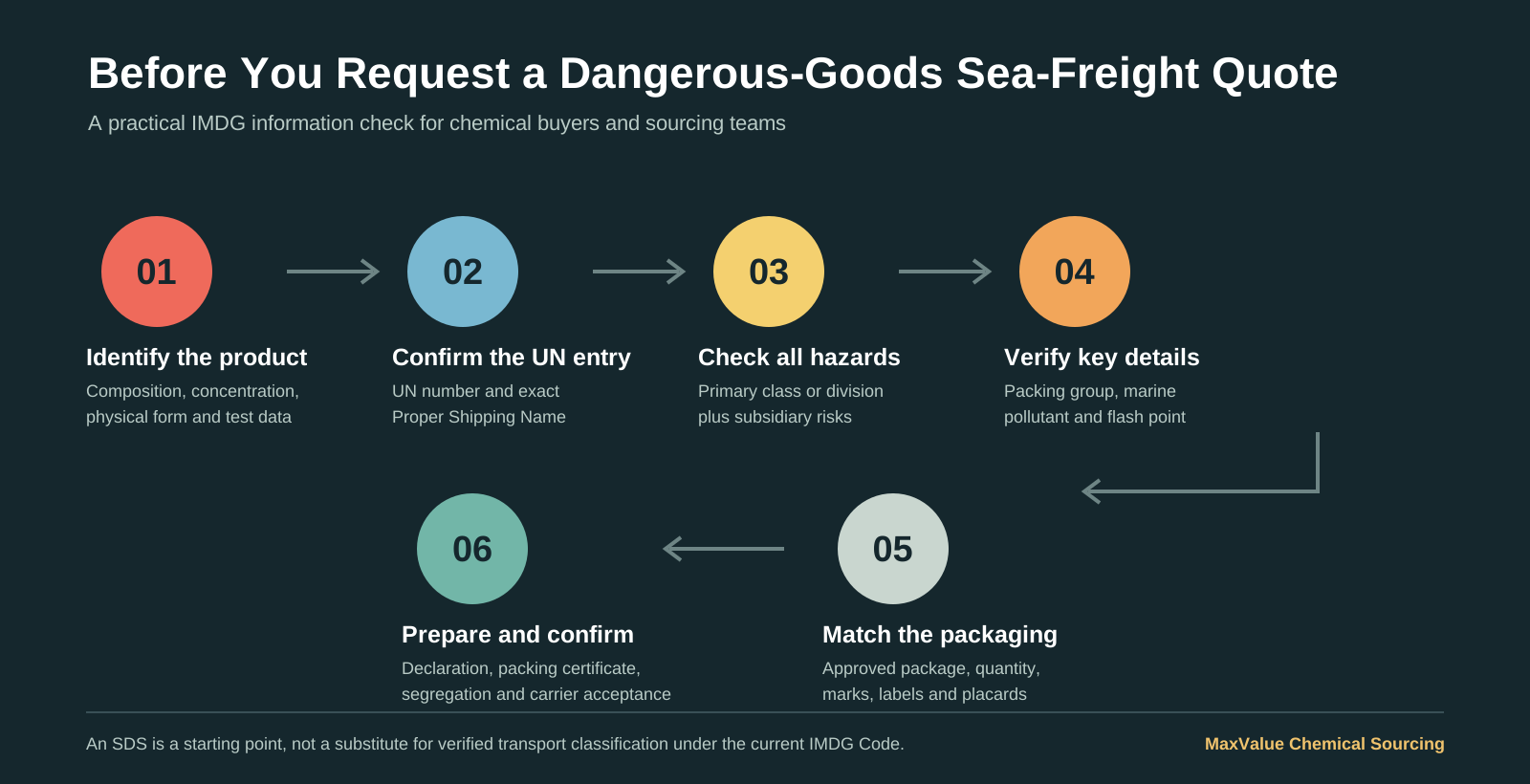
Ask the supplier for the current SDS for the exact grade, plus the proposed UN number, Proper Shipping Name, class or division, subsidiary risk, packing group, marine pollutant status and flash point when relevant. Also confirm package type, package certification, net and gross quantity, package count and container-loading plan.
For the shipment, the responsible parties may need a dangerous goods transport document or declaration, a Container Packing Certificate, compliant package marks and labels, placards on the cargo transport unit, and compliance with stowage and segregation provisions. Carrier templates and cut-off times vary, so booking acceptance should be checked before production or packing is finalized.
Five common classification mistakes
Common errors include copying transport data from an unrelated grade; treating the commercial name as the Proper Shipping Name; omitting a subsidiary risk; assuming every marine pollutant is Class 9; and using an outdated SDS that conflicts with the label, test report or formulation.
Another frequent mistake is quoting ordinary freight first and investigating dangerous-goods acceptance later. This can cause repacking, missed sailings, extra port charges or rejection by the carrier. Classification and route feasibility should be reviewed before the buyer compares landed cost.
How MaxValue-Sourcing supports chemical buyers
MaxValue-Sourcing helps overseas buyers collect and compare supplier documents, align product identity across quotations and SDS files, ask classification questions, review packaging information and coordinate with suppliers or logistics providers. This support helps reveal missing or inconsistent information early.
Final legal classification, declaration and carrier acceptance remain the responsibility of the relevant trained and authorized parties. For a sourcing review, send the product name, CAS number, composition or concentration, application, quantity, packaging and destination port.
FAQ
Which IMDG Code edition is mandatory in 2026?
The IMDG Code 2024 Edition incorporating Amendment 42-24 became mandatory on 1 January 2026. Shipment teams should also check official errata, carrier rules and national requirements.
Are IMDG Classes 1-9 ranked by severity?
No. The numbers identify different types of transport hazard. They do not mean that Class 9 is more dangerous than Class 3 or that Class 1 is always the highest commercial risk.
Is every marine pollutant a Class 9 product?
No. A marine pollutant may have Class 3, 6.1, 8 or another primary hazard and also require the marine pollutant mark. Environmentally hazardous substances assigned to UN 3077 or UN 3082 are common Class 9 examples, but the concepts are not identical.
Is label 9A a separate IMDG division?
No. Label 9A is a Class 9 label design used for specified lithium battery entries. The transport class remains Class 9.
Can an SDS alone confirm the sea-freight classification?
No. Section 14 of a current SDS is an important starting point, but the shipper must verify the composition, test data, UN entry and current IMDG requirements. Generic, outdated or inconsistent SDS documents should be challenged.
Do all dangerous goods have a packing group?
No. Packing groups apply only where the relevant class and entry assign one. Classes 1, 2 and 7, Divisions 5.2 and 6.2, self-reactive substances of Division 4.1 and various articles do not use the normal Packing Group I-III system.
Sources and review basis
This article is based on MaxValue sourcing workflow experience and review of the following practical sourcing materials:
- International Maritime Dangerous Goods Code amendment status
- UN Recommendations on the Transport of Dangerous Goods, Model Regulations
- Official transport-label guidance and current IMO errata
Official references
Check the current official text, amendments and errata before preparing a shipment.
Send your product name, CAS number, target specification, volume and destination. MAX can help screen suppliers, verify factories and coordinate next steps.
Send RFQ to MAX