How to Import Chemicals from China: A Practical 12-Step Guide
Importing chemicals from China is not simply a search for the lowest quotation. The buyer must connect product identity, application performance, supplier capability, documentation, packaging, compliance and transport into one controlled process. This guide explains how overseas buyers can move from an initial requirement to a traceable shipment.
Key takeaways
- Define product identity and application requirements before contacting suppliers.
- Verify the legal seller, manufacturer, payment beneficiary and exporter as separate roles.
- Compare quotations on the same specification, concentration, packaging, Incoterm and service scope.
- Link the approved sample, specification, COA, SDS, label and commercial batch through traceable references.
- Confirm destination-market and transport requirements before production, not after the cargo is ready.
Buyer checklist
- Product name, CAS number, grade, concentration and intended application
- Target specification with units, limits and test methods
- Trial quantity, annual demand, packaging and destination port
- Supplier legal identity, factory or trader role and export capability
- Approved sample, sample COA and commercial-batch equivalence
- Current TDS, SDS, COA format, label and market-specific evidence
- Transport classification, UN details where applicable and carrier acceptance
- Incoterm, payment milestones, inspection plan and deviation procedure
1. Define the chemical before searching for suppliers
Start with an identity sheet, not only a trade name. Record the chemical name, CAS number where applicable, grade, concentration or active content, carrier or solvent, physical form, intended application and any benchmark product. For formulated products such as industrial biocides, adhesives additives or metalworking-fluid components, the same trade description can hide materially different compositions.
Add the specification limits and test methods that affect your process. Buyers in paints, coatings, inks, adhesives, water treatment, leather, wood protection and plastics may care about different properties. A supplier cannot match the application reliably when the request contains only a product name and target price.
2. Check destination-market responsibilities early
Before requesting a commercial shipment, identify who will act as importer and which rules apply in the destination market. Requirements can depend on the substance, mixture, annual volume, intended use and whether the product will be placed on the market or used internally.
For the EU and EEA, a buyer importing directly from outside the region is generally the importer under REACH unless an applicable arrangement changes that role. Registration, restriction, authorisation, classification, labelling and safety-data obligations require product-specific review. A supplier statement such as 'REACH compliant' is not enough unless it identifies the substance, legal entity, use, tonnage and evidence behind the claim.
3. Build a qualified China chemical supplier shortlist
B2B platforms, industry directories, exhibitions, referrals and trade data can all produce leads, but a listing is only a starting point. Search by product identity, application and manufacturing process, then separate probable manufacturers, specialist distributors and general trading companies.
A trading company can be useful when it provides technical communication, supplier coordination, mixed-product consolidation, export documents or quality follow-up. The important question is not factory versus trader in isolation; it is whether each party's role, capability and accountability are transparent.
4. Verify the supplier's identity and manufacturing role
Cross-check the legal name on the business licence, quotation, contract, bank account and export documents. Confirm who manufactures the product, who controls the specification, who sells it, who receives payment and who appears as exporter. Unexplained changes between entities create avoidable legal and payment risk.
For higher-risk or strategically important products, review the production address, business scope, equipment, quality laboratory, raw-material control, batch traceability, capacity, change-control process and complaint handling. A live walkthrough or independent factory visit should test product-specific claims rather than only confirm that a building exists.
5. Compare quotations on one controlled basis
Normalise every offer before ranking suppliers. The comparison should use the same grade, concentration, specification, package size, pallet requirement, quantity, Incoterm, destination, quotation validity, lead time and document scope. A lower price may simply exclude export packaging, dangerous-goods handling, testing, pallets or local transport.
Ask suppliers to identify exclusions and price-adjustment conditions. For recurring purchases, compare trial-order cost and annual-volume cost separately so the first shipment remains realistic while long-term potential is visible.
6. Approve a traceable sample and specification
Request a coded sample with a sample COA, date and clear product reference. Test it in the actual application or through an agreed laboratory method. Appearance alone cannot confirm chemical quality, and a carefully selected sample does not guarantee that future batches will match.
Freeze an approved specification after testing. Record limits, units and methods, and obtain written confirmation that commercial supply will match the approved product. Keep a retention sample when the risk and shelf life justify it.
7. Review COA, TDS and SDS as different controls
The TDS describes typical properties and intended use. The SDS communicates hazard, handling, storage, emergency and transport information. The COA reports results for a specific batch. These documents support different decisions and should not be treated as substitutes for one another.
Check whether product names, composition, concentration, physical properties, revision dates and supplier identity agree across the document set. Review all 16 SDS sections and confirm that the language and format are suitable for the destination. Market-specific legal review remains the importer's responsibility.
8. Confirm transport classification before production
Not every chemical is dangerous goods, and not every hazardous chemical has the same transport classification. For a regulated shipment, confirm the actual product's UN number, proper shipping name, class, subsidiary risk, packing group, marine-pollutant status and packaging instructions with qualified parties and the selected carrier.
The IMDG Code governs packaged dangerous goods carried by sea and covers classification, packing, marking, documentation, stowage and segregation. Carrier acceptance, route restrictions and port requirements can affect cost and lead time, so freight feasibility belongs in supplier selection rather than at the end of production.
9. Put technical and commercial controls into the contract
The purchase contract or order should identify the parties, controlled specification, approved packaging, quantity tolerance, Incoterm, delivery milestones, document list, inspection rights, change notification, nonconformity process and remedies. Payment milestones should follow verified deliverables rather than sales pressure.
Contract language, governing law, jurisdiction and dispute mechanism require qualified legal advice for the actual transaction. Do not copy a generic recommendation from an online article and assume it suits every buyer, seller or country.
10. Approve packaging, labels and container loading
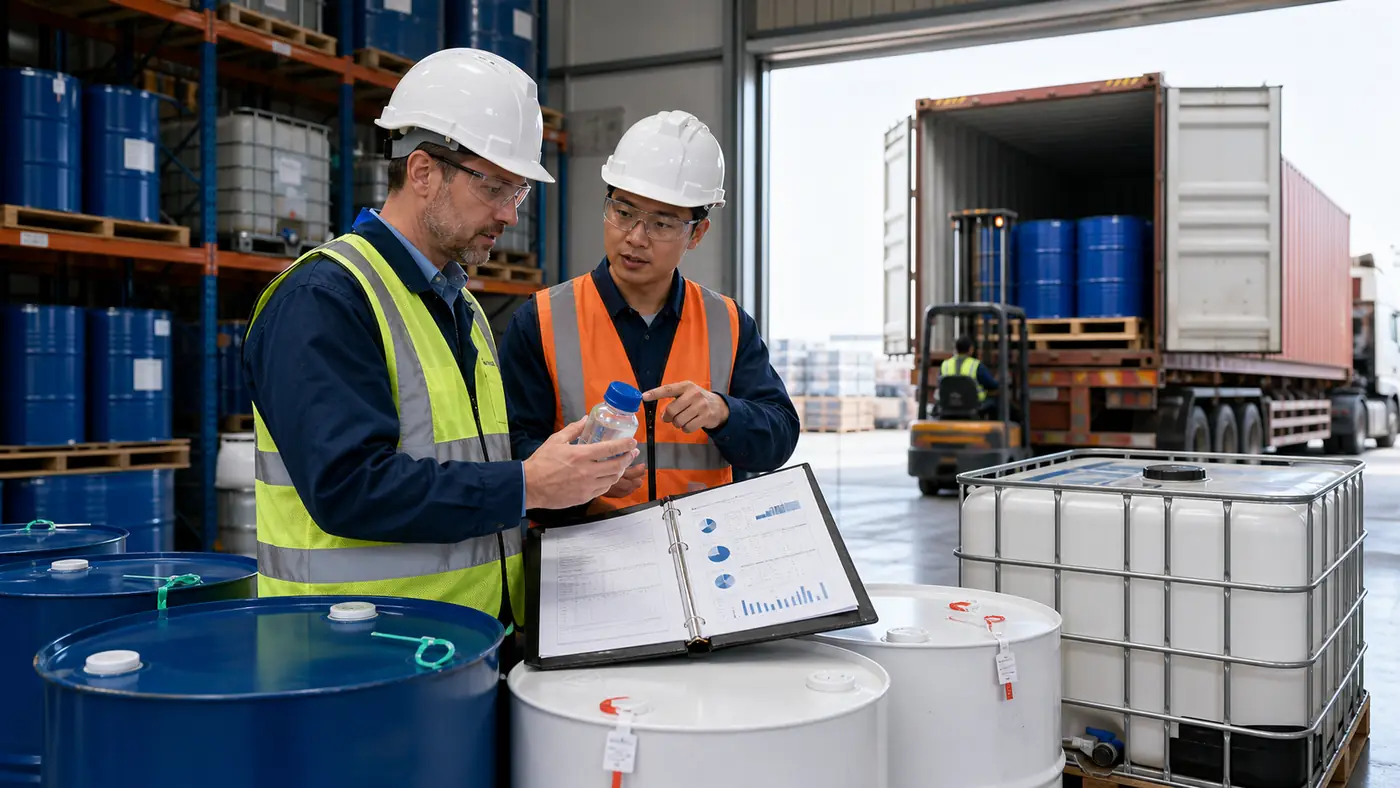
Define drum, bag or IBC material; closure and liner; net weight; pallet type; stretch wrap; marks; label content; batch code; and any dangerous-goods marks. Ask for pre-production or first-pack photos when appropriate. Chemical compatibility and transport approval matter more than visual appearance.
Before loading, check package condition, quantity, batch references, seals, pallet stability, container cleanliness and segregation requirements. Photographic evidence should show the approved details clearly and be linked to the shipment record.
11. Inspect the batch and reconcile shipment documents
Use a risk-based pre-shipment plan. It may include batch COA review, independent testing, package count, net weight, label check, leak inspection, seal verification and container-loading supervision. The objective is to confirm that the cargo matches the approved specification and order before control is transferred.
Reconcile the commercial invoice, packing list, bill of lading instructions, certificate of origin where applicable, SDS and dangerous-goods documents. Names, quantities, weights and package descriptions should agree across the file set.
12. Record delivery performance and prepare the next order
After arrival, record customs issues, package condition, incoming test results, production performance, document accuracy and communication quality. Close deviations with evidence and corrective action. This converts one purchase into a controlled supplier history.
For critical raw materials, qualify a backup source and maintain approved specifications, samples and document revisions. Repeat orders become safer when changes in formulation, process, site, packaging or legal entity must be notified before shipment.
How MaxValue-Sourcing supports chemical imports from China
MaxValue-Sourcing acts as a China chemical sourcing partner for overseas buyers. Support can include requirement clarification, supplier searching and screening, factory-role verification, quotation comparison, sample coordination, COA/TDS/SDS collection, negotiation follow-up, packaging checks, inspection coordination and export shipment communication.
Our focus includes raw materials and formulation components used in paints and coatings, inks, adhesives, industrial water treatment, industrial biocides, leather processing, wood protection, plastics and metalworking fluids. The buyer retains final technical, regulatory, commercial and import approval; our role is to improve local visibility and execution control in China.
FAQ
Can a foreign buyer import chemicals directly from China?
Often yes, but the importer must confirm product-specific import, chemical-control, customs, labelling, storage and transport requirements in the destination. Some substances are restricted, licensed or subject to registration or notification.
What information should I send to a China chemical sourcing agent?
Send the product name, CAS number where applicable, grade, concentration, application, target specification, trial quantity, annual demand, packaging, destination port, required Incoterm and document requirements. A benchmark TDS or approved sample is also useful.
How can I verify a chemical manufacturer in China?
Check the legal entity, production address, business scope, factory role, product-specific equipment, laboratory capability, batch traceability and export history. Use independent records, live video, an on-site visit or third-party inspection according to risk.
Which documents are normally needed to import chemicals?
Common documents include a commercial invoice, packing list, transport document, SDS and batch COA, with certificates of origin, dangerous-goods declarations, test reports, permits or market-specific evidence added where applicable. The exact list depends on product, mode and destination.
Are all chemicals shipped from China classified as dangerous goods?
No. Classification depends on the actual substance or mixture, concentration and applicable transport rules. Do not infer transport status from the product name alone; verify the current classification and carrier requirements for the exact product.
Is buying directly from a factory always better than using a sourcing company?
No. Direct factory purchasing can suit stable, high-volume products, while a specialist sourcing company may add value through local verification, technical communication, multi-supplier coordination, documentation and shipment follow-up. Evaluate transparency and delivered value, not only the supplier label.
Sources and review basis
This article is based on MaxValue sourcing workflow experience and review of the following practical sourcing materials:
- LinkedIn article: How To Import Chemicals From China by Calisto Radithipa (2015)
- MaxValue supplier screening, quotation comparison and export coordination workflow
- Current official importer, hazard communication and sea-transport guidance linked below
Official references
Check the current official text, amendments and errata before preparing a shipment.
Send your product name, CAS number, target specification, volume and destination. MAX can help screen suppliers, verify factories and coordinate next steps.
Send RFQ to MAX